

Stay informed, stay ahead
  • REVISION OF AUDIT EXEMPTION THRESHOLD

    On 16 December 2024, the Companies Commission of Malaysia revised the qualifying criteria for the audit exemption of private companies (Sdn Bhd). Prior to the amendment, only dormant/zero-revenue companies, and companies with revenue not exceeding RM100,000 are eligible for audit exemption.

    Under the new criteria, private companies will qualify for audit exemption if it fulfils at least two (2) of the following criteria:

    1. The annual revenue of the company during the current financial year and in the immediate past two (2) financial years do not exceed RM3,000,000;
    2. The total assets of the company in the current statement of financial position and in the immediate past two (2) financial years do not exceed RM3,000,000; or
    3. The number of employees at the end of the current financial year and in the immediate past two (2) financial years do not exceed thirty (30).

    Do note that the audit exemption revenue threshold relaxation will be implemented over a period of three (3) years on staggered basis (as shown below), starting from RM1,000,000 in 2025, RM2,000,000 in 2026 and RM3,000,000 in 2027. The maximum number of employees will also be increased incrementally from 10 employees to 30 employees in 2027.
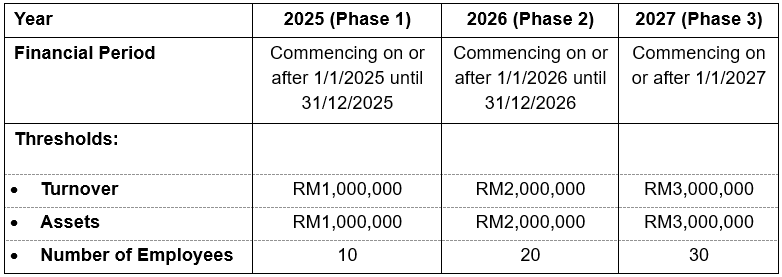
    Audit exemption thresholds: turnover, assets and number of employees for 2025, 2026 and 2027

    Through audit exemption, companies that have elected to be exempted from audit are still required to prepare and submit its Unaudited Financial Statements with the Companies Commission of Malaysia.

    We wish to highlight that audit exemption does not apply to the following categories of companies:

    1. An exempt private company which has opted to lodge a certificate relating to its status as an exempt private company;
    2. Public companies;
    3. A private company that is a subsidiary of a public company; and
    4. Foreign companies
  • New COMPANY NUMBER FORmat

    On 11 October 2019, Companies Commission of Malaysia (“CCM”) has implemented the new 12 digit format for the registration number of business entities registered with CCM. This new format of Business Registration Number will replace the existing registration number in CCM.

    The new registration number format that consists of 12 digit numbers denote the following:

    1. First 4 digits – the year of business entity was registered
    2. Subsequent 2 digits – business entity code
    3. Last 6 digits – the registration number sequence

    Example of the new registration number format is as follows:-

    SSM 12 digit company number format

    The 2 digit business entity code classifies companies into the following categories:-

    01 – Local company
    02 – Foreign company
    03 – Business (sole proprietor/partnership)
    04 – Local Limited Liability Partnership
    05 – Foreign Limited Liability Partnership
    06 – Limited Liability Partnership for Professional Practice

    During the transitional period, the existing registration number can still be used until further notice. Business entities are therefore not required to amend its existing company letterhead, invoices, signboards and all other printed documents. However, business entities are encouraged to use the new registration number format as soon as possible so that the company is prepared when the new registration number format is fully enforced.

    You are able to check the new business registration number of your company via SSM’s e-Search

    You may also refer to SSM’s FAQ for more information on the new business registration number or you may download the FAQ here.

  • REGISTRATION OF REPRESENTATIVE OFFICE IN MALAYSIA

    Representative Office is a good alternative for foreign companies who wish to explore market potentials or investment opportunities in Malaysia prior to setting up a permanent establishment.

    The key features of a Representative Office in Malaysia are:-

    1. it does not carry out any business activities in Malaysia (accordingly it should not receive any income derived from Malaysia);
    2. only represents its head office/principal to undertake designated functions;
    3. has its own office premise and facilities;
    4. it is fully funded from sources outside Malaysia such as its parent company, or from the company’s operation outside Malaysia (proposed operational expenditure must be at least RM300,000 per annum);
    5. does not participate in the management and administration of any joint venture companies, subsidiaries, affiliates or branches in Malaysia;
    6. does not sign any business contracts on behalf of the parent company or provide services for a fee; and
    7. does not lease warehousing facilities. Any shipment, transhipment or storage of goods shall be handled by a local agent or distributor.

    Examples of permitted activities of a Representative Office in Malaysia are:-

    • Conducting market research or surveys;
    • Undertaking feasibility studies on investment opportunities in Malaysia and the region;
    • Acting as a referral and/or liaison centre;
    • Seeking out local agents and/or distribution networks;
    • Providing after sales service;
    • Planning or coordination of business activities;
    • Carrying out manufacturing surveys;
    • Identifying sources or raw materials, components or other industrial products;
    • Research & development activities;
    • Acting as a coordination centre for the company’s affiliates, subsidiaries and agents in the region; and
    • Other activities which will not result directly in actual commercial transactions.

    The Representative Office may also apply for Expatriate Post for the parent company to post its staff to Malaysia. The number of Expatriate Post allowed will depend on the functions and activities of the Representative Office, and only managerial or technical positions will be considered for the position of Expatriate Post.

    As the Representative Office is not allowed to carry on business in Malaysia, it is not subject to tax. The Expatriate working in a Representative Office in Malaysia however is subject to normal income tax.

    All applications for registration of Representative Office (except for services related to banking, financial and tourism) should be submitted to Malaysian Investment Development Authority (MIDA).

    Do contact our trusted personnel at RISS should you need help/ guidance for your application.

  • Sdn Bhd vs llp

    We were often asked to compare the difference between Sdn Bhd and LLP. We have collated a few of the most frequently asked questions and have listed them below for your information. We hope you find them useful.

    SDN BHDLLP
    Do I need to audit my company accounts?YesNo
    Do I need to file annual statement with Companies Commission of Malaysia?YesYes
    Do I need a Company Secretary?YesNo
    Is there a different tax rate for Sdn Bhd and LLP?Sdn Bhd and LLP have similar corporate tax rate and treatments
  • FUNDING FOR THE CREATIVE INDUSTRY

    The Malaysian Government is spreading some love to the creative industry as well.

    If you are a business owner in the following activities, then you will be eligible to apply:-

    1. Visual Arts (e.g. Paintings & Sculptures)
    2. Performing Arts (e.g. Theater & Dancing)
    3. Music (e.g. Recording Studios & Music Academy)
    4. Literature (e.g. Book Publisher)
    5. Content Creation (e.g. Cinematic and TV Content)
    6. Fashion and Design (e.g. Couture & Fashion Academy)
    7. Traditional and Cultural Arts (e.g. Songket & Crafts)

    Read More

  • WHAT IS THE PURPOSE OF A REGISTERED OFFICE?

    Often times, when setting-up a new private limited company (Sdn Bhd) or Limited Liability Partnership (LLP) in Malaysia, information of registered office/ address is required. Some of you will opt to use your business address as the registered office whilst the rest will have them located at the office of the Company Secretary. Have you ever wondered why Registered Office is required though? I mean, other than it being required by law that every company must have a registered office, do you really know why it is required?

    Read More

  • WHAT IS THE DIFFERENCE BETWEEN AUTHORIZED SHARE CAPITAL AND PAID-UP SHARE CAPITAL?

    Authorized Share Capital is the amount of shares that a company is authorised to issue and it forms no part of the actual Paid-up Share Capital of the company. In layman term, Authorized Share Capital is basically the company’s quota for share issuance. Whereas, Paid-up Share Capital is the actual shares of the company issued to its shareholders after consideration for the shares, be it cash or non-cash, have been deposited with the company.

    Read More

  • FUNDING OPPORTUNITIES & TAX INCENTIVES FOR MALAYSIAN INCORPORATED COMPANIES – PART 3

    In the final and last part of this post, we’ll discuss about the most helpful tool offered by Cradle Fund ie Coach & Grow Programme. Other than coaching the business owners, Coach & Grow Programme also provides grants to the business owners under Cradle Investment Programme (CIP) if the company fulfills the conditions under the respective grants.

    So if you have a good product idea or already has a company generating revenue and is looking to achieve sustainable growth and going global, this programme is perfect for you as it is crafted to provide entrepreneurs with the tools and ‘show-how’ to develop and implement strategies and plans during commercialisation and growth stages. It also equip companies that have growth potential to scale and go global.

    Read More

  • FUNDING OPPORTUNITIES & TAX INCENTIVES FOR MALAYSIAN INCORPORATED COMPANIES – PART 2

    This is the second part to our first blog post. In Part 1, we started with the funding opportunities under Cradle Investment Programme (CIP) whereby grants are given for start-up companies to conduct product commercialization and prototype development. You may find Part 1 of this post here.

    In this second part, we’ll proceed to the tax incentive provided under Cradle Fund. The tax incentive provided by Cradle Fund is offered via ANGEL TAX INCENTIVE (ATI) programme.

    Read More

  • FUNDING OPPORTUNITIES & TAX INCENTIVES FOR MALAYSIAN INCORPORATED COMPANIES – PART 1

    For entrepreneurs who are thinking of venturing/ or have just started a business in ICT, Bio-Technology & Life Sciences, Material Sciences and High Growth Technology industries or generation of ideas for an Innovative Knowledge-Based society and economy, this is good news for you as there is an opportunity for you to qualify for funding by Cradle Fund.

    Read More